
Muscle deep-dives
Trapezius trigger points: referred pain, palpation and release
A clinical deep-dive on Trapezius: trigger point locations, the referred pain pattern they produce, palpation landmarks, activating factors and an evidence-based release protocol.
Published:
Why this muscle causes pain
The upper trapezius runs from the base of the skull and cervical spine to the lateral clavicle and acromion. It elevates and upwardly rotates the scapula and helps stabilize the head. Trigger points here are widespread in desk workers and anyone holding sustained shoulder elevation.
Where the trigger points sit
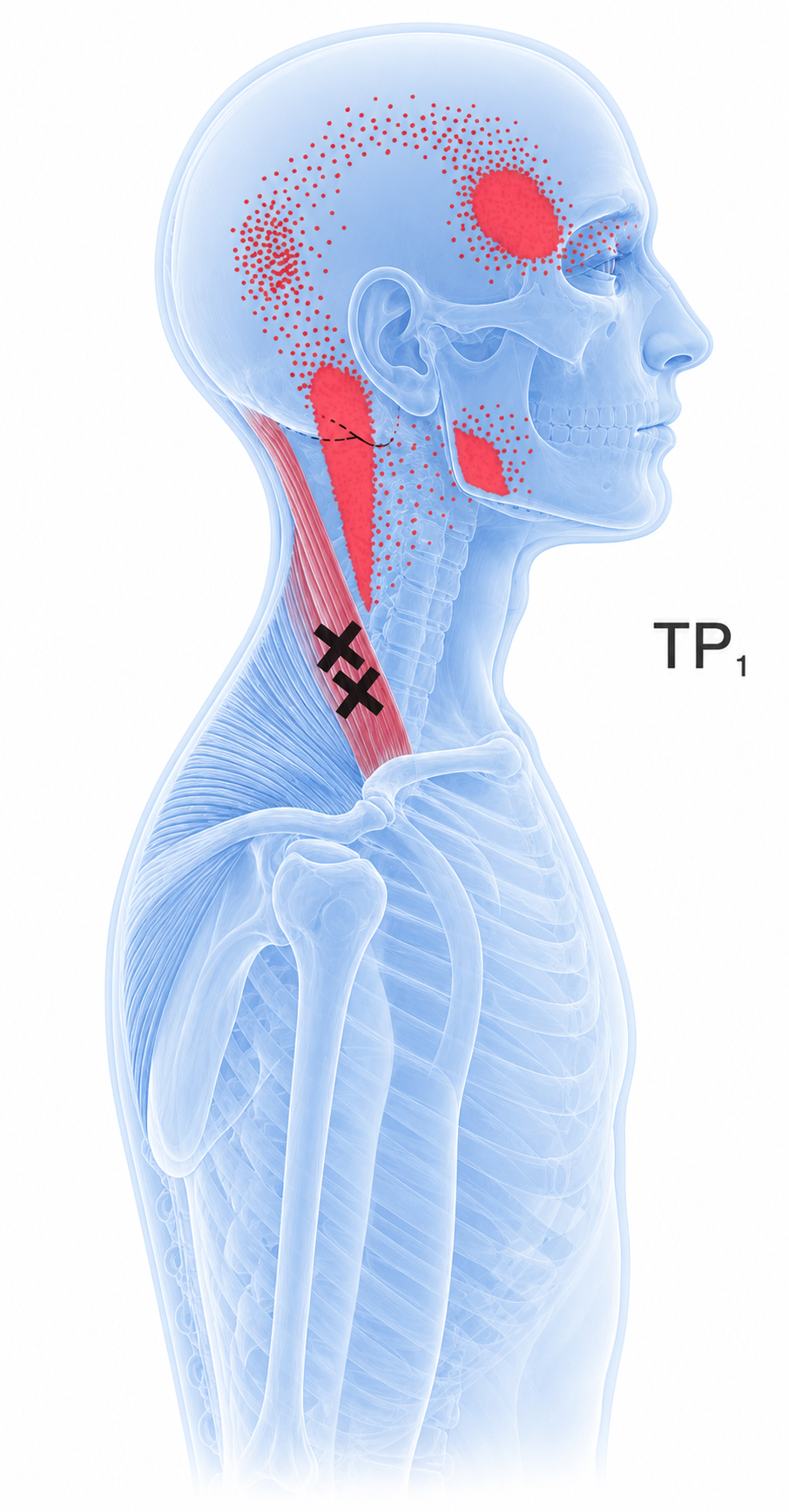
Two classic locations: TrP1 in the midpoint of the upper fibers along the shoulder ridge, and TrP2 slightly more medial and posterior. Both are easy to palpate as taut bands.
The referred pain pattern
Pain refers up the side of the neck to the temple and angle of the jaw, often described as a unilateral tension headache. May also refer to the back of the ear.
How to find it by palpation
Pincer grip the upper fibers between thumb and index finger. A taut band reproduces local pain and often the patient's referred headache.
What sets it off
Sustained shoulder elevation (laptop work, carrying bags), forward head posture, stress-related bracing, whiplash, asymmetric monitor or phone use.
Self-care that actually helps
Sustained pressure release with a ball against a wall, slow chin tucks, scapular setting drills. Clinically: dry needling, manual ischemic compression, and ergonomic correction of monitor and chair height.
Stretching and mobility
Side-bend the head away from the painful side, gently rotate the chin toward the same shoulder, and apply mild overpressure with the opposite hand for 30 seconds. Keep the painful-side shoulder pinned down (sit on the hand) to lengthen the upper fibers. Repeat 2–3 times per side, twice a day.
Symptoms this muscle produces
Clinically, this muscle turns up in the workup of back of head pain, back of neck pain, cheek pain (like sinusitis), headaches or migraines, temple and eyebrow pain and temporal headache (temples). Those are the complaints its referral zone overlaps, which is why a patient may present with any of them and never mention the muscle itself.
FAQ
- Why does my temple hurt when the pain seems to come from my shoulder?
- The upper trapezius has a well-documented referred pain pattern that travels up the neck to the temple — pain felt in the head can originate from a trigger point on the shoulder ridge.
Muscles covered
Studies cited
Every claim in this article traces back to one of the sources below.
- Kietrys 2013 — Effectiveness of dry needling for upper-quarter myofascial pain: a systematic review and meta-analysis. J Orthop Sports Phys Ther 2013;43(9):620-34 ↗
- Gattie 2017 — The effectiveness of trigger point dry needling for musculoskeletal conditions by physical therapists: a systematic review and meta-analysis. J Orthop Sports Phys Ther 2017;47(3):133-49 ↗
- Boyles 2015 — Effectiveness of trigger point dry needling for multiple body regions: a systematic review. J Man Manip Ther 2015;23(5):276-93 ↗
- Charles 2019 — A systematic review of manual therapy techniques, dry cupping and dry needling in the reduction of myofascial pain and myofascial trigger points. J Bodyw Mov Ther 2019;23(3):539-46 ↗
- Cagnie 2013 — Physiologic effects of dry needling. Curr Pain Headache Rep 2013;17(8):348 ↗
- Fernández-de-las-Peñas 2019 — Trigger point dry needling for the treatment of myofascial pain syndrome: current perspectives within a pain neuroscience paradigm. J Pain Res 2019;12:1899-911 ↗
- Shah 2015 — Myofascial trigger points then and now: a historical and scientific perspective. PM R 2015;7(7):746-61 ↗
- Halle 2016 — Pertinent dry needling considerations for minimizing adverse effects. Int J Sports Phys Ther 2016;11(5):651-62 ↗
- Boyce 2020 — Adverse events associated with therapeutic dry needling. Int J Sports Phys Ther 2020;15(1):103-13 ↗
- Hong 1994 — Lidocaine injection versus dry needling to myofascial trigger point: the importance of the local twitch response. Am J Phys Med Rehabil 1994;73(4):256-63 ↗
- Simons & Travell — Myofascial Pain and Dysfunction: The Trigger Point Manual (2nd ed.). Williams & Wilkins, Baltimore ↗