
Muscle deep-dives
Infraspinatus trigger points: referred pain, palpation and release
A clinical deep-dive on Infraspinatus: trigger point locations, the referred pain pattern they produce, palpation landmarks, activating factors and an evidence-based release protocol.
Published:
Why this muscle causes pain
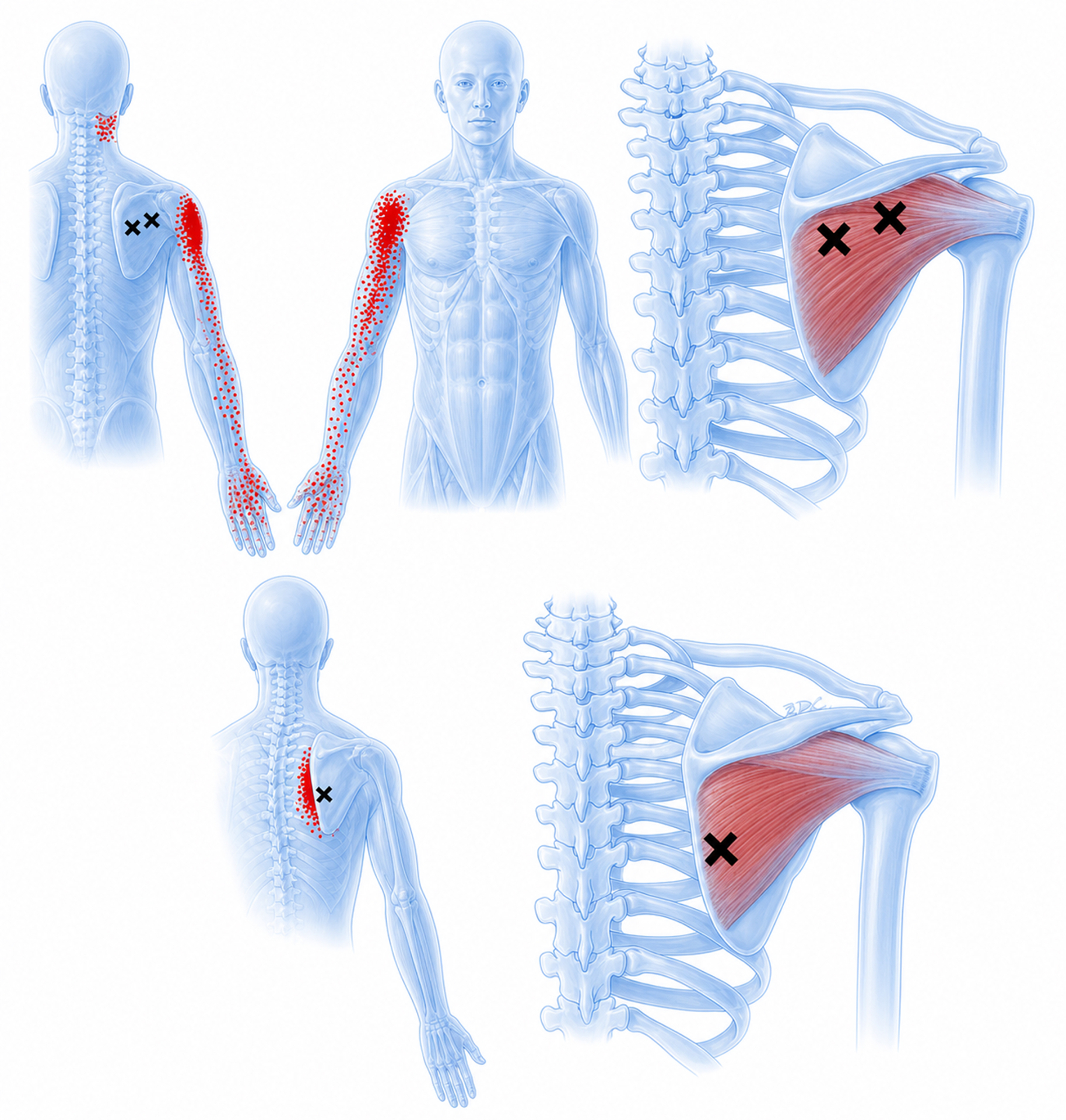
Fills the infraspinous fossa of the scapula and inserts on the greater tubercle of the humerus. External rotator of the shoulder and dynamic stabilizer of the glenohumeral joint. Trigger points are extremely common in throwing athletes and desk workers.
Where the trigger points sit
Two primary points in the muscle belly, slightly inferior to the spine of the scapula. Often very tender even without complaints when palpated.
The referred pain pattern
Deep anterior shoulder pain (felt 'inside' the joint), spreading down the lateral arm and sometimes into the forearm and radial hand.
How to find it by palpation
With the patient prone or side-lying, palpate just below the spine of the scapula. A taut band reproducing the patient's anterior shoulder pain is diagnostic.
What sets it off
Overhead activity, throwing, sleeping on the shoulder, scapular dyskinesis, frozen shoulder.
Self-care that actually helps
Lacrosse ball against the wall on the infraspinous fossa, sleeper stretch with care, scapular control work. Clinically: dry needling is particularly effective here.
Symptoms this muscle produces
Clinically, this muscle turns up in the workup of back of neck pain, front of arm pain, front of shoulder pain, mid-thoracic back pain, painful weak grip and problems holding arms up (as when folding sheets). Those are the complaints its referral zone overlaps, which is why a patient may present with any of them and never mention the muscle itself.
Muscles covered
Studies cited
Every claim in this article traces back to one of the sources below.
- Kietrys 2013 — Effectiveness of dry needling for upper-quarter myofascial pain: a systematic review and meta-analysis. J Orthop Sports Phys Ther 2013;43(9):620-34 ↗
- Gattie 2017 — The effectiveness of trigger point dry needling for musculoskeletal conditions by physical therapists: a systematic review and meta-analysis. J Orthop Sports Phys Ther 2017;47(3):133-49 ↗
- Boyles 2015 — Effectiveness of trigger point dry needling for multiple body regions: a systematic review. J Man Manip Ther 2015;23(5):276-93 ↗
- Charles 2019 — A systematic review of manual therapy techniques, dry cupping and dry needling in the reduction of myofascial pain and myofascial trigger points. J Bodyw Mov Ther 2019;23(3):539-46 ↗
- Cagnie 2013 — Physiologic effects of dry needling. Curr Pain Headache Rep 2013;17(8):348 ↗
- Fernández-de-las-Peñas 2019 — Trigger point dry needling for the treatment of myofascial pain syndrome: current perspectives within a pain neuroscience paradigm. J Pain Res 2019;12:1899-911 ↗
- Shah 2015 — Myofascial trigger points then and now: a historical and scientific perspective. PM R 2015;7(7):746-61 ↗
- Halle 2016 — Pertinent dry needling considerations for minimizing adverse effects. Int J Sports Phys Ther 2016;11(5):651-62 ↗
- Boyce 2020 — Adverse events associated with therapeutic dry needling. Int J Sports Phys Ther 2020;15(1):103-13 ↗
- Hong 1994 — Lidocaine injection versus dry needling to myofascial trigger point: the importance of the local twitch response. Am J Phys Med Rehabil 1994;73(4):256-63 ↗
- Simons & Travell — Myofascial Pain and Dysfunction: The Trigger Point Manual (2nd ed.). Williams & Wilkins, Baltimore ↗