
Muscle deep-dives
Sternocleidomastoid trigger points: referred pain, palpation and release
A clinical deep-dive on Sternocleidomastoid: trigger point locations, the referred pain pattern they produce, palpation landmarks, activating factors and an evidence-based release protocol.
Published:
Why this muscle causes pain
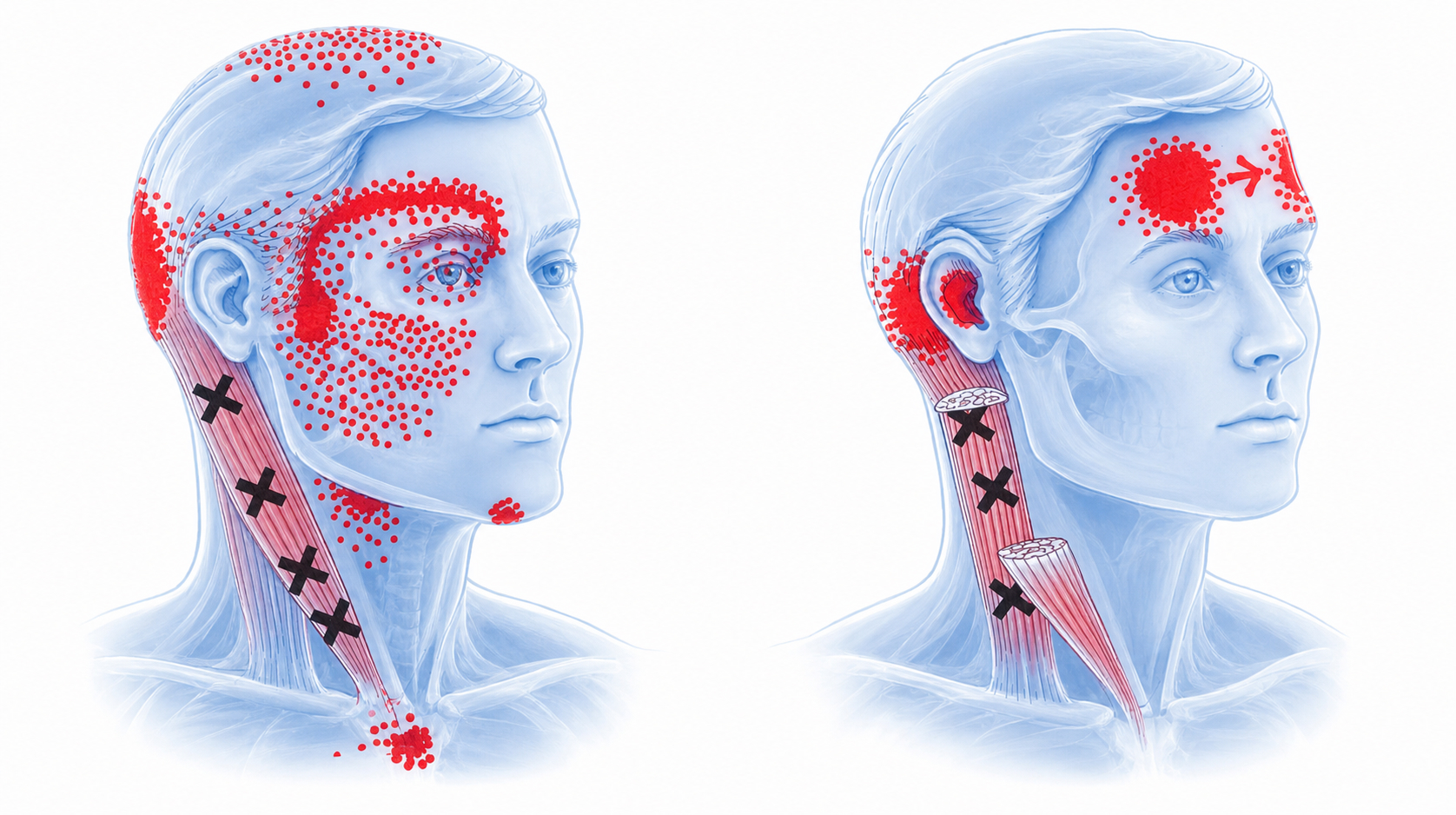
The SCM has two heads (sternal and clavicular) running from the mastoid process to the sternum and clavicle. It rotates the head to the opposite side and flexes the neck. Trigger points here can produce symptoms that look neurological: dizziness, blurred vision, tinnitus.
Where the trigger points sit
Trigger points are spread along both heads. The sternal division tends to refer to the cheek, eye and forehead; the clavicular division to the ear, frontal region and behind the ear.
The referred pain pattern
Sternal division: forehead, behind the eye, cheek, throat. Clavicular division: forehead across the brow, ear, deep ear pain, and sometimes the molar teeth.
How to find it by palpation
Pincer grip the muscle gently with the head slightly rotated and tilted away. Taut bands are easy to roll between the fingers. Compare sides.
What sets it off
Whiplash, prolonged head rotation (sleeping position, side monitor), forward head posture, chronic cough, mouth breathing.
Self-care that actually helps
Gentle pincer self-massage in supine, postural correction, breathing retraining. Clinically: manual therapy, dry needling with care due to vascular structures.
Stretching and mobility
Sit tall, tuck the chin gently, then tilt the ear away from the side being stretched while rotating the head toward the same side. Hold 20–30 seconds, 2–3 times per side. Do not push through dizziness — release immediately if symptoms appear.
Symptoms this muscle produces
Clinically, this muscle turns up in the workup of back of head pain, cheek pain (like sinusitis), dizziness when turning head or changing field of view, double/blurry/jumpy print vision, ear pain and earaches/tinnitus (ringing)/itch. Those are the complaints its referral zone overlaps, which is why a patient may present with any of them and never mention the muscle itself.
Muscles covered
Studies cited
Every claim in this article traces back to one of the sources below.
- Kietrys 2013 — Effectiveness of dry needling for upper-quarter myofascial pain: a systematic review and meta-analysis. J Orthop Sports Phys Ther 2013;43(9):620-34 ↗
- Gattie 2017 — The effectiveness of trigger point dry needling for musculoskeletal conditions by physical therapists: a systematic review and meta-analysis. J Orthop Sports Phys Ther 2017;47(3):133-49 ↗
- Boyles 2015 — Effectiveness of trigger point dry needling for multiple body regions: a systematic review. J Man Manip Ther 2015;23(5):276-93 ↗
- Charles 2019 — A systematic review of manual therapy techniques, dry cupping and dry needling in the reduction of myofascial pain and myofascial trigger points. J Bodyw Mov Ther 2019;23(3):539-46 ↗
- Cagnie 2013 — Physiologic effects of dry needling. Curr Pain Headache Rep 2013;17(8):348 ↗
- Fernández-de-las-Peñas 2019 — Trigger point dry needling for the treatment of myofascial pain syndrome: current perspectives within a pain neuroscience paradigm. J Pain Res 2019;12:1899-911 ↗
- Shah 2015 — Myofascial trigger points then and now: a historical and scientific perspective. PM R 2015;7(7):746-61 ↗
- Halle 2016 — Pertinent dry needling considerations for minimizing adverse effects. Int J Sports Phys Ther 2016;11(5):651-62 ↗
- Boyce 2020 — Adverse events associated with therapeutic dry needling. Int J Sports Phys Ther 2020;15(1):103-13 ↗
- Hong 1994 — Lidocaine injection versus dry needling to myofascial trigger point: the importance of the local twitch response. Am J Phys Med Rehabil 1994;73(4):256-63 ↗
- Simons & Travell — Myofascial Pain and Dysfunction: The Trigger Point Manual (2nd ed.). Williams & Wilkins, Baltimore ↗