
Symptoms
Thumb Pain and Tingling Numbness (Dysesthesia): Trigger Points and Muscles Involved
Region: Forearm and Hand
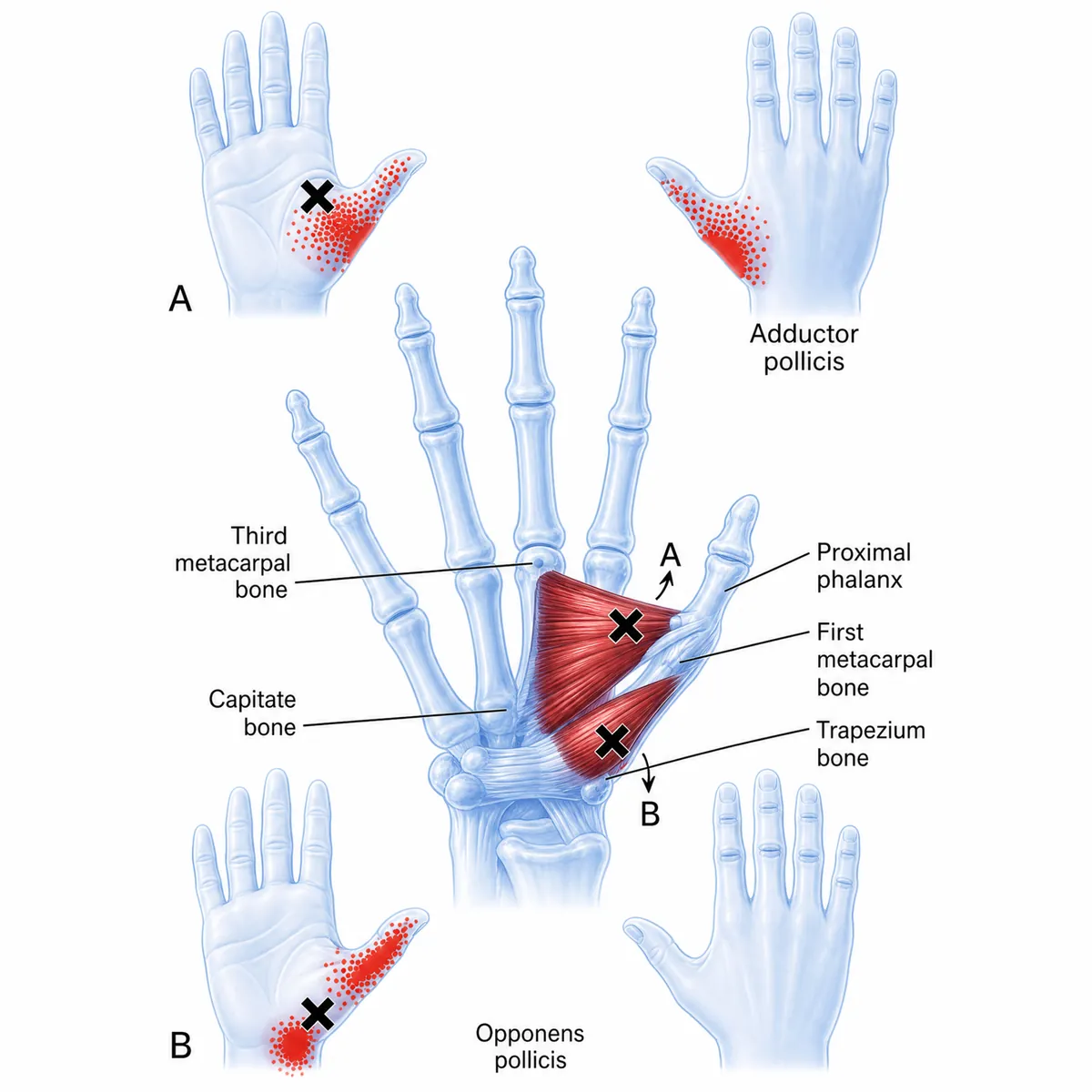
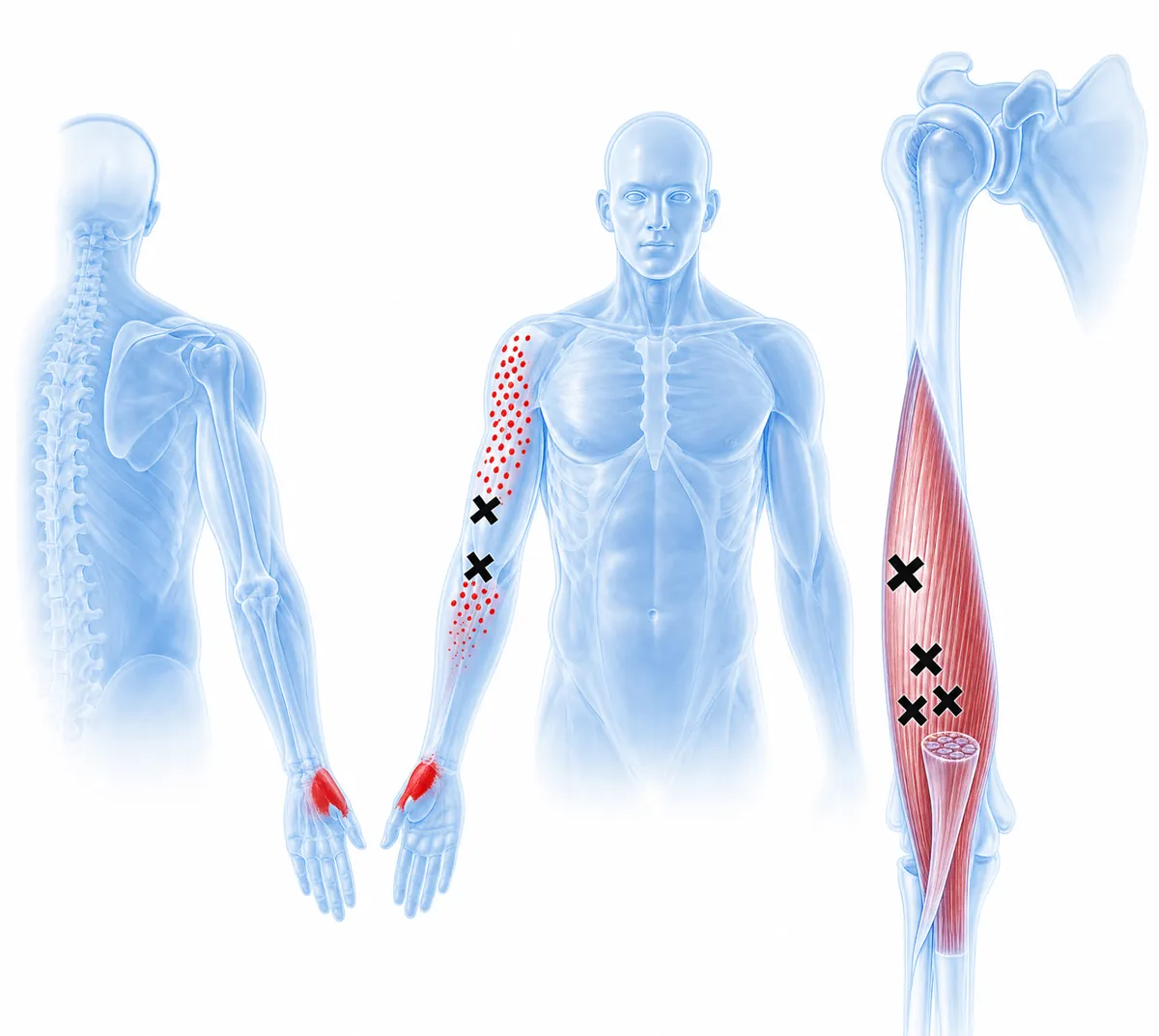
Thumb Pain and Tingling Numbness (Dysesthesia): trigger points and referred pain. Primary muscles in this reference: Adductor Pollicis, Brachialis, Opponens Pollicis.
Overview
The primary muscles listed for Thumb Pain and Tingling Numbness (Dysesthesia) are Adductor Pollicis, Brachialis, Opponens Pollicis. Trigger points can produce referred pain: discomfort is felt away from the tender muscle. “Muscle knots” is an everyday description, whereas myofascial pain is the clinical term used in the linked references. This is a reference association, not proof that a muscle causes this symptom. A pain map cannot rule out joint, nerve or internal-organ conditions. Match the exact location and circumstances, rather than treating every tender spot as the source.
The primary associations for Thumb Pain and Tingling Numbness (Dysesthesia) are Adductor Pollicis, Brachialis, Opponens Pollicis. Primary, secondary and tertiary describe the reference's ordering, not a diagnosis or a measured probability. The following extracts describe each muscle's complete referral pattern; not every area mentioned is necessarily part of your symptom.
Adductor Pollicis — Local web-space pain, sometimes spreading into the palm.
Brachialis — Base of the thumb, lateral elbow, and anterior elbow crease.
Opponens Pollicis — Local thumb base pain, often felt as 'arthritic' CMC pain.
Record where Thumb Pain and Tingling Numbness (Dysesthesia) occurs, which position or activity changes it, and whether it is accompanied by numbness, weakness or another symptom. Compare those observations with the linked muscle maps. A clinician can assess whether palpation reproduces the familiar complaint; tenderness alone does not establish the cause. Do not press deeply into the throat, abdomen or other sensitive areas to test a theory.
For Thumb Pain and Tingling Numbness (Dysesthesia), begin with assessment of the symptom rather than assuming that release is needed. Where a muscular contribution has been assessed, the linked pages for Adductor Pollicis, Brachialis, Opponens Pollicis describe their existing self-care options, loading factors and precautions. Read those precautions before trying an exercise. Dry needling and injections are clinician-only procedures. Do not use a referral map to delay care or to stop an established treatment.
Adductor Pollicis — Pinch-grip overload, manual tools, gardening. Palpate the muscle belly along its accessible course. Reproduction of the patient's familiar pain on palpation supports involvement. Web-space release, ergonomic correction. Clinically: gentle needling.
Brachialis — Heavy carrying, climbing, sustained typing. Palpate the muscle belly along its accessible course. Reproduction of the patient's familiar pain on palpation supports involvement. Eccentric elbow flexion, self-release at the lower anterior arm. Clinically: needling.
Seek medical assessment for Thumb Pain and Tingling Numbness (Dysesthesia) when it is new, persistent, worsening or unexplained. Muscle associations are educational information, not a way to exclude other causes. The existing warning signs for this entry are: Acute trauma, deformity — refer.
For an appointment about Thumb Pain and Tingling Numbness (Dysesthesia), bring a short record of the symptom rather than only the name of a suspected muscle. Note the activity before it started, whether the location has changed and what has already been tried. These observations help a professional compare the muscular associations with alternative explanations without relying on the atlas alone.
Primary Symptoms
Related articles
FAQ
- Which muscles are listed for Thumb Pain and Tingling Numbness (Dysesthesia)?
- Adductor Pollicis, Brachialis, Opponens Pollicis. This is a reference association, not proof that a muscle causes this symptom. A pain map cannot rule out joint, nerve or internal-organ conditions. Match the exact location and circumstances, rather than treating every tender spot as the source.
- How can I check the pattern of Thumb Pain and Tingling Numbness (Dysesthesia)?
- Record where Thumb Pain and Tingling Numbness (Dysesthesia) occurs, which position or activity changes it, and whether it is accompanied by numbness, weakness or another symptom. Compare those observations with the linked muscle maps. A clinician can assess whether palpation reproduces the familiar complaint; tenderness alone does not establish the cause. Do not press deeply into the throat, abdomen or other sensitive areas to test a theory.
- Does Thumb Pain and Tingling Numbness (Dysesthesia) prove I have trigger points?
- This is a reference association, not proof that a muscle causes this symptom. A pain map cannot rule out joint, nerve or internal-organ conditions. Match the exact location and circumstances, rather than treating every tender spot as the source.
References
- • Travell & Simons — Myofascial Pain and Dysfunction
Medically reviewed by: Marco Aruffo — physiotherapist since 2006, specialised in myofascial pain · Last reviewed: